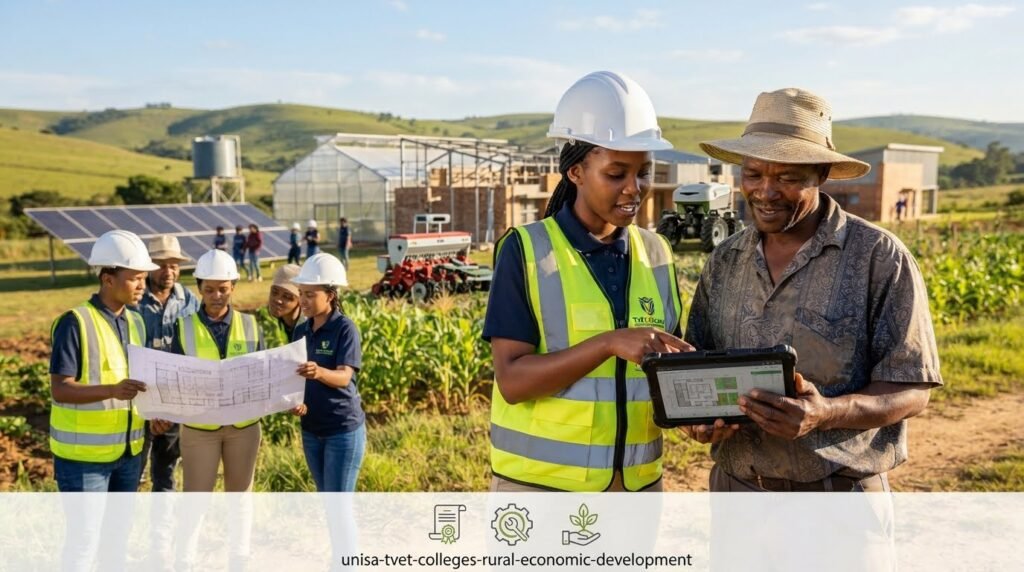

For a young person living in a rural community, getting access to the right education can be only the beginning of a much bigger challenge. Finding reliable internet, gaining practical workplace experience, accessing modern technology and identifying local employment opportunities can all influence whether a qualification leads to a sustainable career.
This is one of the issues being addressed through collaboration between the University of South Africa (Unisa), Maluti TVET College and Goldfields TVET College. The institutions have brought together educators, researchers and post-school education stakeholders to explore how education, vocational training and technology can contribute to economic development in rural South Africa.
Their discussions are important because rural development requires more than making qualifications available. Students also need relevant skills, access to technology, opportunities to apply what they learn and connections with the industries operating around them.
Unisa and TVET Colleges join forces to support rural communities
The partnership was a central focus of the Second Annual Seminar jointly hosted by Unisa, Maluti TVET College and Goldfields TVET College.
The event took place on 6 and 7 October 2026 at the Thabo Mofutsanyana District Municipality Chamber in the Old Parliament Building in Phuthaditjhaba, Free State.
Under the theme Harnessing Education, Training and Technology for Rural Economic Development: A Pathway to Transformation, participants considered how institutions can work together to improve teaching, strengthen graduate employability and make education more responsive to community and industry needs.
The seminar brought together representatives from universities, TVET colleges and other organisations involved in South Africa’s post-school education and training sector.
The important message was that educational institutions cannot work in isolation if they want their programmes to respond effectively to economic challenges. Universities can contribute research and academic expertise, while TVET colleges provide vocational and practical training. Employers and community organisations can help identify the skills and experience needed in local economies.
Why rural communities need stronger education partnerships
Rural communities have economic potential, but young people may face barriers that make it difficult to participate fully in the economy.
These can include limited access to digital devices, expensive internet connectivity, fewer nearby training facilities and a shortage of opportunities to gain workplace experience.
A qualification may provide important knowledge, but students also need opportunities to use that knowledge in real situations.
This is where cooperation between universities and TVET colleges becomes valuable. Institutions can share research, exchange teaching experience, identify gaps in existing training and explore ways to connect qualifications with practical economic activities.
The seminar highlighted the importance of making education relevant to the places where students live. Instead of viewing rural areas only as places from which young people must leave to find work, skills development can also help communities identify opportunities for local enterprise and employment.
Technology could change access to learning
Digital innovation was another major theme of the discussions.
Technology can help students access learning resources, communicate with lecturers, participate in online activities and develop skills needed in modern workplaces. However, these benefits are not automatic.
A student without a suitable device, affordable data or a reliable connection may struggle to benefit from online learning. Rural digital development therefore requires attention to infrastructure, affordability and digital literacy.
During the seminar, participants explored the possibility of establishing digital skills hubs within rural TVET colleges. Such hubs could create opportunities for students and surrounding communities to develop digital capabilities.
It is important to understand that the discussion of digital hubs is not the same as confirmation that new facilities have already opened at every participating college. It identifies an area of potential development that requires planning, resources and implementation.
The seminar also included a demonstration of artificial intelligence tools facilitated by Unisa’s Academic Development Open Virtual Hub Unit. This gave participants an opportunity to consider how emerging technology could be used in education and training.
For students, the broader lesson is that digital literacy is becoming increasingly important across different careers, including administration, finance, engineering, agriculture and business.
Practical skills must connect with real economic needs
One of the strongest ideas emerging from the seminar was the importance of linking training with the needs of employers and communities.
TVET colleges have an important role in preparing students for practical occupations and workplace responsibilities. However, training is more useful when its content reflects the skills that industries actually require.
Participants discussed stronger relationships between colleges and employers, including work-integrated learning opportunities.
Work-integrated learning allows students to connect classroom knowledge with workplace experience. Depending on the qualification and arrangement, this may involve workplace exposure, practical projects or supervised learning activities.
For a rural student, access to these experiences can make a difference when preparing for employment.
The seminar also considered hospitality graduates who move into entrepreneurship. This is an important part of the discussion because economic development cannot depend on formal employment alone. Some graduates may use their skills to establish small businesses, provide services or develop products that meet local demand.
However, entrepreneurship also requires more than technical knowledge. Business planning, financial management, access to markets and mentorship can influence whether a small enterprise survives.
Renewable energy and digital skills offer areas for development
The discussions also explored renewable energy training and the role of technology in supporting rural economic activity.
As energy systems develop, communities may need people with skills in electrical work, installation, maintenance, energy management and related technical services.
Training in these areas could help prepare young people for changing industry requirements. It may also support local service businesses where there is demand for qualified and competent workers.
The seminar’s focus on renewable energy should not be interpreted as an announcement of guaranteed jobs or funded training places. It highlights an area in which relevant skills development and partnerships may contribute to future economic opportunities.
Participants also considered the importance of encouraging more women to pursue science, technology, engineering and mathematics (STEM) studies. Improving access and support in these fields can help broaden participation in industries where technical knowledge is increasingly important.
Student support and inclusive education remain essential
Access to a course does not automatically mean every student will complete it successfully.
Students may experience academic difficulties, financial pressures, disability-related barriers or personal circumstances that affect their studies.
The seminar therefore included discussions about strengthening student support services. A presentation by Unisa Senior Student Counsellor Nteeng Moatlhodi examined a framework for improving support services, drawing on a case study of South African TVET colleges.
Other topics included lecturer development, support for undergraduate students with low vision and the alignment of occupational qualifications with industry requirements.
These discussions matter because rural development should not leave students with disabilities or those from disadvantaged backgrounds behind. Accessible learning materials, appropriate support and inclusive teaching practices are part of building a stronger education system.
What does this mean for South African students?
For current university and TVET students, the collaboration offers several practical lessons.
First, students should pay attention to the skills required in their chosen industries. A qualification is important, but digital literacy, communication, problem-solving and practical experience can strengthen career preparation.
Second, learners should investigate work-integrated learning opportunities connected to their courses. They can ask their institutions about workplace placement requirements, industry partnerships and available practical training arrangements.
Third, students in rural areas should look for ways to develop digital skills using accessible learning resources. These skills can support studies and prepare learners for workplaces that increasingly rely on technology.
Finally, young people interested in entrepreneurship should consider how their training could solve problems in their own communities. Local demand, available resources and access to markets are important factors when assessing a business idea.
A partnership that needs practical follow-through
The collaboration between Unisa, Maluti TVET College and Goldfields TVET College demonstrates the value of bringing different education institutions together to discuss rural development.
The seminar created a platform for exchanging research, discussing digital innovation and identifying areas where training can respond more effectively to economic needs.
However, lasting change will depend on what happens after the discussions. Digital facilities need resources, lecturers require ongoing development, and industry partnerships must create meaningful opportunities for students.
For rural communities, the real measure of success will be whether collaboration eventually improves access to relevant education, practical skills, technology and sustainable livelihoods.
CareersFocus will continue sharing education, skills development and career information that helps South Africans understand opportunities available through universities, TVET colleges and other institutions.
Useful links
- University of South Africa (Unisa)
- Maluti TVET College
- Goldfields TVET College
- Department of Higher Education and Training
Editorial note: This article is an original explanation of the issues and discussions described in Unisa’s report on the Second Annual Seminar. It does not claim that CareersFocus attended the event or independently interviewed its participants. The digital skills hubs and other ideas discussed should be understood as areas explored during the seminar, not confirmed nationwide services or guaranteed student opportunities.
Disclaimer: https://careersfocus.co.za/ is an independent education and careers information publisher. It is not affiliated with Unisa, Maluti TVET College or Goldfields TVET College. Students should contact the relevant institution directly for official information about courses, admissions, funding and available programmes.